

Introduction
Fleet tracking systems have become standard equipment for logistics, transportation, construction and delivery companies across global markets. The whole real-time location monitoring, route management and vehicle safety functions rely heavily on GPS antennas. Many fleet operators and GPS hardware manufacturers often encounter signal loss, positioning deviation, weak outdoor reception and short service life caused by low-quality antennas. Selecting a durable, stable and vehicle-grade GPS antenna directly cuts fleet maintenance costs and improves the accuracy of your tracking devices. This guide shares practical standards for fleet business buyers to pick suitable GPS antennas.
1. Prioritize vehicle-grade waterproof & dustproof structure
Fleet vehicles work in complex outdoor environments: high temperature in summer, heavy rain, muddy roads and long-time vibration during driving. Ordinary indoor GPS antennas cannot withstand such harsh conditions.
Qualified fleet-use GPS antennas adopt IP67 or above waterproof housing. The sealed casing prevents rainwater, dust and moisture from entering internal signal chips. Shock-resistant internal design avoids loose components under continuous vehicle vibration, maintaining steady positioning signal all day long. For fleets operating in tropical areas like Thailand, Vietnam and Southeast Asia, high-temperature resistant shell material is also a must-have feature.
2. Check signal receiving stability for continuous tracking
Stable satellite signal is the core demand of fleet management. Poor antennas often lose GPS signals when vehicles pass tunnels, tall buildings or suburban wooded areas, leading to missing location records and failed route monitoring.
High-performance fleet GPS antennas use high-sensitivity GNSS chips, supporting multi-satellite systems including GPS, GLONASS and BeiDou. Strong signal gain ensures fast satellite locking within seconds after vehicle startup, and maintains smooth positioning even under weak signal surroundings. For long-distance cross-country fleets, multi-system compatible antennas effectively reduce positioning blind spots.
3. Match the installation & wiring requirements of tracking devices
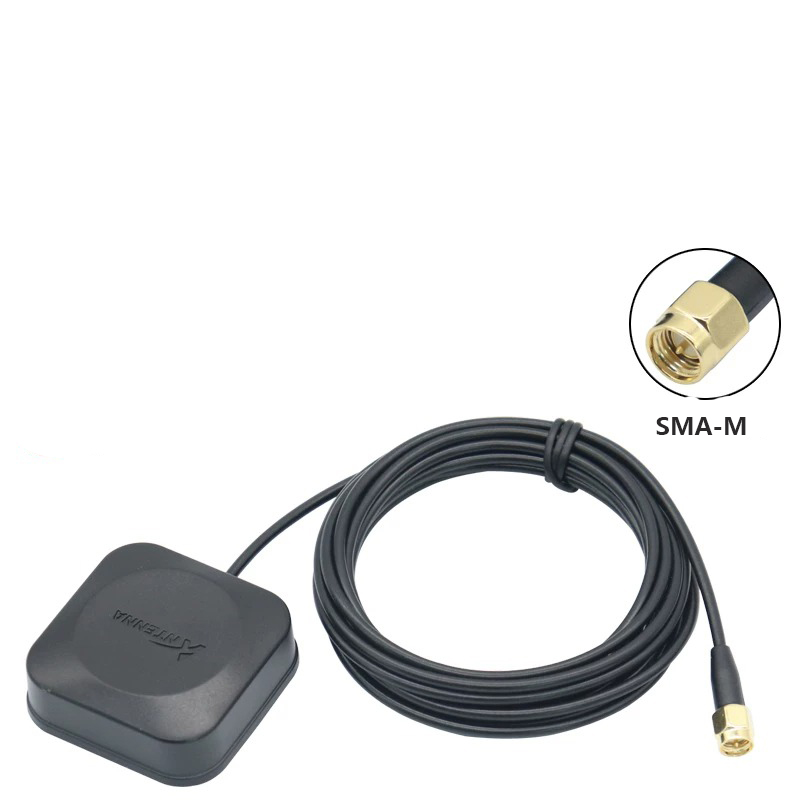
Most fleet GPS trackers, TCU devices and vehicle monitoring terminals have unified external antenna interfaces. Before purchasing, confirm the connector type (usually SMA or SMB) to avoid incompatible installation.
Compact flat paddle antenna design is widely welcomed by fleet companies. It can be easily attached to vehicle roofs, windshields or hidden inside car cabins without occupying extra space. Long enough extension cables are necessary for flexible installation on different vehicle models, from light delivery vans to heavy-duty trucks. Integrated GPS+GSM combo antennas are a cost-saving choice for fleet businesses, which only needs one installation position to support both positioning and cellular data transmission.
4. Focus on long service life to lower replacement frequency
Fleet operators purchase antennas in bulk for dozens or hundreds of vehicles. Frequently replacing faulty antennas creates extra labor and procurement expenses.
High-quality vehicle GPS antennas use anti-aging cable and corrosion-resistant metal internal parts, supporting 3–5 years of continuous daily operation. Cheap low-cost antennas often suffer cable cracking, signal attenuation and chip failure within one year, bringing extra troubleshooting work to fleet management teams. For large fleet tracking equipment suppliers, long-lifespan antennas also help improve after-sales satisfaction of their complete tracking systems.
5. Pick suppliers with consistent batch quality
Fleet businesses usually place bulk orders of hundreds or thousands of antennas. Uneven quality between different batches will cause inconsistent tracking performance on your vehicles.
Cooperate with professional RF antenna manufacturers focusing on automotive accessories. Mature manufacturers implement unified production testing for every finished antenna to guarantee consistent signal performance of all goods. Stable supply capacity also ensures fast delivery for your restocking demands without delaying fleet equipment deployment.
Conclusion
A high-performance GPS antenna is the invisible core supporting efficient fleet management. When sourcing antennas for fleet tracking business, do not only compare unit prices. Evaluate waterproof grade, signal sensitivity, structural durability and batch quality comprehensively. Proper vehicle-grade GPS antennas minimize positioning failures, reduce maintenance work and help fleet companies and GPS device manufacturers deliver stable, reliable tracking solutions to end users.
If you are looking for stable automotive GPS and combo antennas for your fleet tracking business, welcome to visit our official website to view full product ranges.
 Deutsch
 Español
 Français
 Italiano
 Português
 日本の
日本の 한국어
한국어 العربية
 български
 hrvatski
 česky
česky Dansk
Dansk Nederlands
 suomi
suomi Ελληνικά
 हिन्दी
 norsk
norsk Polski
 Română
 русский
 Svenska
 中文
中文